Originally posted in 2013
Tormented by grey hair and ever-deepening furrowed lines above our brows as we grow older, my two brothers and I seem to more and more resemble each other; in our days of youthful wonder you may not have believed we were spooned from the same kettle.
Our father was a handsome man, his olive complexion, square jaw, black hair and blue eyes stood in contrast to our mother’s fair skin, softly cleft chin, honey blonde hair and brown eyes so dark her pupils are barely perceivable, she was a natural-born beauty… together they were an attractive couple. Through some combination or another of our parent’s genetic pools, three sons in four years, all different in physical appearance, came into this world.
My oldest brother Randall’s hair was nearly white and straight as a freshly milled board, black horned-rimmed glasses sat on his fair-skinned nose and starkly framed his sea green eyes. David, fifteen months my elder, had curly and brilliantly auburn hair and blue eyes, freckles the color of his hair scattered across his checks and nose in contrast to his fair skin. I got my mom’s chin, my dad’s darker complexion, my light brown hair, with a prominent cow-lick jutting from the front, was usually streaked by the sun.
Our dad gave us each a nick-name; “Cotton-Top”, “Red”, and me, well I had two… “Stan the Man”, the other… “Shorty”… I don’t know if this was because I was the youngest of the three or if it was because I was as stubborn as my granddaddy’s old mule… his name was “Shorty” too; having spent some time in reflection about this, and considering David and I were pretty much the same size, I believe it was more than likely the latter.
Our mother called us by our names, sorta… Randall was called “Randall”, David was “Randall David” and I was “Randall David Stan”
My cousin Alan, three months younger than me and nearly always with us, rounded out the “Four Musketeers” as we fancied ourselves. Mama called him “Randall David Stan Alan”.
Every three or four weeks, usually before we went to visit somebody, these four heads of hair had to be cut; at some point in time my father decided it was cheaper to buy clippers and borrow mama’s scissors and do the job himself.
A chair was placed in the middle of the living room, its polished hardwood floors were easier to clean up after the carnage I suppose. One by one we waited for the inevitable. Once you agreed that you understood the warning to “sit still or your head will look lopsided”, an old towel was draped over your shoulders and around your neck; this was held tightly in place and closed by a clothes pin… following another reminder of the previously understood warning the hum of the clippers could be heard; all hope of escaping, hair intact, ended when the first swipe was made.
Mama decided who got what hairstyle among her three sons; I guess my Aunt Liz told her brother, the Uncle-slash-barber, what Alan would get. The other three seemed to always get the much preferred “pineapple” (a little longer on the top, crew cut on the side); since I had the clump of hair in the front of my head that jutted straight up and wouldn’t lay down flat, no matter how much “mama spit” was applied to it, got a crew cut.
In the days when America was torn apart over the war in Viet Nam, the division of beliefs was sometimes identified by long or short hair; there was little doubt about where my family stood. Democracy ended at the front door and choices about what was good for us were left to the adults. Pleas to “please, please, please let my hair grow out like the other kids” fell on deaf ears. This was how things were done.
At some point in our young lives we each received a small Basset pocket knife. The small, shiny knife didn’t have a sharp edge on any of its three blades; there was a bottle opener, a nail file and a small cutting blade with a dull rounded edge… We calculated its uses were limited to pulling splinters and such out of your fingers, digging in the dirt or slicing through blades of grass or bugs. This all changed when one of us figured out that if you pulled all three blades out, to various degrees, you could effectively create a 3-pronged treble-hook. A long piece of string tied through the hole in the back-end made for a convenient way to retrieve it after you threw it at something.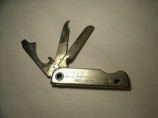
In those days we hunted for anything that we supposed could be handled by a bunch of little boys. Ants and little brown wood scorpions were common prey until one day someone had the bright idea to hurl our knives at a wasp’s nests.
The inanimate knife didn’t really get much response from the wasps other than to cause a few to buzz out a foot or so and then return back to the hive; more than a few, of the unfortunate sort, met an untimely and unforeseen death, skewered by our 3-pronged dealers of death.
We would harass the wasps until we got tired of chucking our knives at them, something else better presented itself or the nest fell to the ground. Happily, none of us ever got stung, our knives with the long string attached, kept us at a safe distance. We had no idea what torments would one day descend upon us.
Every few weeks Mama would call us into formation and perform the “behind the ears cleanliness inspection”… this was followed by orders to go to our rooms and put on clean clothes. Once this was accomplished, we would all pile into my daddy’s two-door, baby blue and white ’57 Chevrolet Belair, and make our way into the country, 35 miles or so, to my Great-Grandmother’s house.
Mama Rawlins, as we called her, lived in a house that was so old it seemed it must have surely been there from the beginning of time. I don’t believe you could have broken into or snuck up on anybody undetected in that house because the floors creaked under the weight of every step. If somebody got up in “the other room” you knew about it before their second foot hit the floor.
The land that surrounded the house had been farmed for generations by the Rawlins family and was divided down the middle by Temple-Johnson Road. Why on earth this dirt and gravel road was named Temple-Johnson I do not know, in those days you couldn’t throw a rock anywhere on it without hitting someone named Rawlins or Cole.
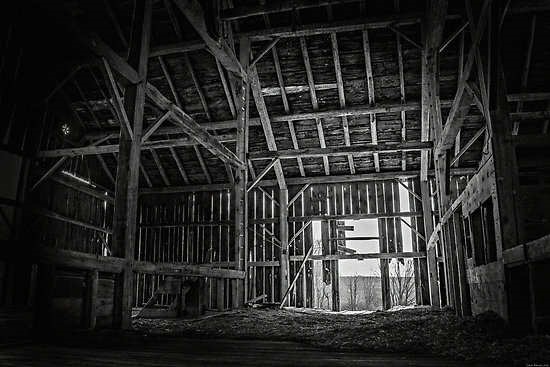
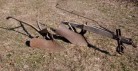
On one side of the road was Mama Rawlins’ house and on the other was a large barn, no longer in use, it sat silent. The barn was surrounded by large open fields. The field’s soil showed signs of the plows; small slopes up and valleys down formed a patchwork pattern that laid out where the different vegetables had once been planted. The rows were all covered by clumps of green and brown grasses, an occasional stump, sticking up a few feet, broke-up the patterns.
I am not certain how old the barn was. I do remember once seeing a picture of a woman, clad in a dress, an apron over the top of it, standing beside an extremely large man with a moustache reminiscent of those sported by men in the age of the Civil War. The two stood posed like statues in front of a barn; given the size of the men in my family, I have always assumed the man in the picture was somehow related to us. The grainy black and white picture made the barn look like it was already old.
This bottom of the barn had several openings; these were divided by heavy timbers that rose up from the ground vertically to the floor of the hay loft. These vertical timbers were so large that they likely weren’t milled, but rather, hand sewn using a two-handled blade. Heavily knotted pieces of lumber, unsuitable for structural support, were nailed horizontally to the tall timbers to create stalls, storage rooms and also provided a place to hang farming tools. On one side, where I imagined huge plows were once placed, Mama Rawlins parked her seldom driven and dust-covered Ford Falcon.
With no electricity, the only light source in the barn was the sun, shadows slowly making their way across it as the sun made its journey each day from dawn to dusk. It became darker the further you ventured past the openings.
A handmade ladder, its square rungs worn down in the middle by boots covered in muck and then sanded smooth by callused hands, provided the way up and into to the hay loft. The loft had a solid floor and A-framed rafters covered by ancient tin, formed the roof.
The roof, once a protector of all it rose above, having been battered by the wind and hail of countless thunderstorms now surrendered little rays of light. On one end the large door was open, its oversized steel hinges rusted and bent, wouldn’t close. The remnants of old straw, gathered in the corners, gave the loft a memorable sour and musty smell.
This barn held a special fascination for the four of us, there was much to be explored. Antique tools, covered with years of spider webs and dust, were lifted from wooden walls and inspected in an attempt to reason their purpose; in my mind I imagined that the big man with the moustache had used them and was greatly impressed with myself that I could pick them up and wield them around. I also wondered why they now hung from the walls, unmoved and unused for years. Mule collars were tried on for size and plow shares were skimmed along the dirt floor leaving a scratched row with little footprints on either side of it.
Unknown to us, the hour of our reckoning approached as we made our way up the ladder and into the loft. The A-frame cross beams were connected in the middle by a main beam and were low enough that if you jumped you could grab them, the only obvious danger being the rough cut hole in the floor where the ladder breached it.
At the time a little hand-over-hand monkey bars style traversing of the beams seemed a good thing to do, so we all, one by one leaped up and latched a hold of them and moved along. It never occurred to us that the energy from small boys, testing our strength on the heavy timber beams, was transferred down the length of them. It also never occurred to us to check out the beams before we started climbing all over them.
Eventually, as normally occurred when we were together, a challenge to see who could travel the farthest without letting go was issued. As was also normal for the four of us knot-headed boys, when the gauntlet was thrown, lest you be deemed a coward and undeserving of your mother’s love…you couldn’t back down; this accounted for most of the knots on our heads.
It was all fun and games when we started, but after a few minutes one of us, I blame my brother David for it (you’ll understand why later), got close enough to the end of a beam to disturb what must have been one of the earth’s greatest wonders… the largest wasp’s nest I have ever seen, before or since. I don’t want to exaggerate but saying it was the size of an aircraft carrier seems appropriate.
At once all of these creatures, known in scientific terms as is Polistes Carolina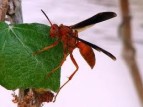 (I refer to them as the orange and black incarnations of the devil himself) swarmed down, around and upon us in such a fashion that I am sure, had it been captured on 16 millimeter film, the great military minds of today could study and learn a thing or two from it.
The offensive began with what felt like a splinter in my finger but quickly turned into a machine gun spray of stingers as the great horde of inhumanity directed its assault to every part of my body.
Alan, who was closest to me and also immersed in this cloud of pain, lost the voluntary control of his body, the manner of his snapping back and forth violently let me know I wasn’t in this battle against nature alone.
Randall, as best as I can remember, was near the ladder and made his way down it, his one or two stinging humiliations at the hands of the throng were a small discomfort when compared to the agony Alan and I were enduring.
Meanwhile, “The instigator” dropped from the beam and stood there in the middle of all of this, screaming his fool head off. This is apparently an effective defensive tactic when overrun by the evil orange and black incarnations of the devil himself.
Alan and I ran the length of the loft and launched ourselves out of it and through the air; I guess we assumed a quick death or broken legs from the fall seemed a better option at that point in time. The wasps, not satisfied that we had suffered enough indignity, gave us each another sting or two for good measure on our way out and down.
“The instigator”, red-faced by now from his apparently effective defensive tactic against the orange and black incarnations of the devil himself, was snatched by the collar of his shirt to safety by my father who had scampered up the ladder. David was the only one of us who escaped the marauding defenders of the nest unscathed.
Alan and I were promptly marshaled to Mama Rawlins’ house where she took charge of our triage and treatment. A bleach, Band-Aids and tobacco cure were ordered up, while awaiting these we were stripped naked.
When the prescribed cure arrived, Mama Rawlins gave orders to “close your eyes and shut your mouth”. Bleach was then doused over our heads and bodies… snuff, taken straight from Mama Rawlins’ mouth, was smeared across the affected areas… and finally, a Band-Aid with a pinch of cigarette tobacco in the gauze part was applied to each sore and still swelling sting.
It was obvious, to all who witnessed it, that Mama Rawlins had dealt with knot-headed little boys and their battles against nature before.
Battered and beaten, swollen from the top of my now bleached blonde head to the tips of my little toes, I would recuperate… we all would… and live to fight another day.
I will state it now for the record, may it find its rightful place in the history books and annals of knot-headed boys everywhere, that from that day until this one, I blame my brother David, “The Instigator”, for what ensued that fateful day.
In my wasp humbled opinion, he should rightfully accept full responsibility and accountability for starting the “Great Wasp Payback Revolution of 1970”.
After that day, I never again entered that wooden and tin gateway to hell… The barn was later torn down, and a good riddance if you ask me… so that my grandparent’s new house could be built on the spot.
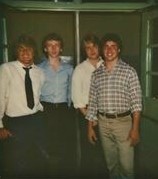
(L-R) Stan, The Instigator, Randall, Alan 1981
So what’s the lesson…Be careful of the details… something taken for granted can change your happy day into a bad one you’ll never forget. The biggest lesson I learned from that day, and it’s one of the most important lessons I could have learned being a firefighter and a chief officer, was that you never just charge in, you make a plan of attack after you gather as much information as you can. As a kid I was able to heal from my wounds, if not the embarrassment of being stripped naked in front of Mama Rawlins. But in the fire service leaping before you look can have much graver consequences.
Please folks, share some of your lessons from life in the comments below. I really do want to hear from you.
Until next time,
“Randall David Stan”
 Life Makes Leadership